09 February 2008

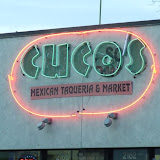
Cuco's Mexican Taqueria and Market


I had heard so much buzz about Cuco's that I just had to go and see for myself. It was definitely worth the trip, with good food, great prices and a plethora of veggie-friendly dining options.

There are numerous establishments in and around Columbus that peddle similar wares as Cuco's--that is, traditional Mexican fare. Most of these establishments (Las Margaritas, El Vaquero, et al.), however, are not nearly as good at this seemingly simple task.

The first bonus points for Cuco's are earned by the menu clearly designating all vegetarian items. I love this attention to my dietary restrictions.

The chips and salsa they bring to the table are very good. Even better is the salsa bar, where you can self serve a variety of salsas with endless chips to shovel the sauces into your mouth.

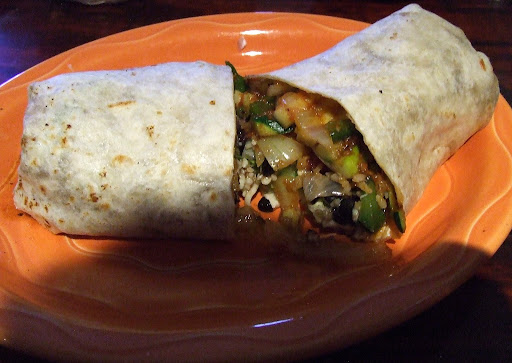
The guacamole was tasty, with chunks of onion and tomato integrated into the spicy avocado paste. My entree was the vegetarian burrito, pictured above, with rice, green peppers, onions, black beans and a few other grilled vegetables wrapped with cheese and guacamole in a tortilla. There are only two words to describe it: muy sabroso.

The service was also very quick. The entrees came out less than 10 minutes after they were ordered. It was extra impressive because the food was made by hand and did not taste like it had been sweating under a heat lamp all night.

Some of the other interesting looking vegetarian items include the avocado sandwich, quesadillas, nachos and the veggie fajitas. The sandwiches looked especially delicious.

Probably the weakest link was the margaritas. They were decent but not spectacular. There is a limited tequila menu. Although they don't short you on tequila, the drinks were not quite up to the excellent quality of the food. The bar crowd, however, didn't seem to mind. Maybe next time I'll stick with Negra Modelo.

There is also a little market area that sells a limited selection of Latin grocery items. This is a very good Mexican restaurant. If you're looking for high end food or Tex Mex options, you might have to look elsewhere. But if you enjoy traditional Mexican food that doesn't break the bank, Cuco's is definitely a winner.

Bonus: Everybody else loves Cuco's too. Check out the reviews here, here and here. The Cuco's Web site also has a ton of pictures of the inside of the restaurant and the food. Be warned...unlike my pictures, it is not all vegetarian.


Cucos

Cuco's Mexican Taqueria on Urbanspoon

07 February 2008

Look Before You Eat


If you eat out often, you will either want to ignore or pay close attention to the Men's Health article about the 16 secrets the restaurant industry doesn't want you to know.


If ignorance is bliss, don't read this. If you fear eating an appetizer with 2,900 calories, read on.


Some offenders in the article are better than others. Places like
Applebee's advertise low fat items that are laden with calories and carbohydrates. Hooters sneaks all sorts of unpronounceable chemicals into its chicken wings. Arby's puts artificial flavoring into its "All Natural" chicken because the FDA can't regulate the term "All Natural" (Luckily, little of this affects my vegetarian eating habits).


But there are a few more insidious culprits. IHOP offers a 1,335 calorie omelet with more saturated fat than a crock of Crisco. Outback Steakhouse was the guilty party with the 2,900 calorie appetizer. I'm sure they meant you to share it.


There are a number of other establishments that offer food with artificial coloring (Panera Bread), fry French toast with four grams of fat per stick in oil laden with trans fat from their poorly prepared pork, chicken and fish menu items (Burger King) and sell smoothies with more than 60 grams of sugar (Dunkin Donuts).


The worst offenders, like Fuddruckers, Maggiano's Little Italy and Red Robin, refused to release the information to the authors of the article. Apparently restaurants are now allowed to plead the fifth.


The article in Men's Health describes how professional restaurant organizations and the Governator in California ignored legislation that simply would have required restaurants to post nutritional information on their menus. Apparently ignoring this practical suggestion might help to explain why Arnold is looking so soft around the midsection (the article is in Swedish, but don't worry--you don't need a translator to understand the pictures).


The consumer is responsible for what they put into their body. But being unable to figure out what crap is in the food you're eating makes keeping tabs a difficult proposition. I don't eat at these places, but on behalf of those who do, it's about time that the powers that be allowed the public to know exactly what they are eating.

If I buy a 9-millimeter hand gun, it would be fairly easy for me to judge what would happen to me if I point the gun at myself after firing it at a practice target a few times. Without being able to find out how many calories are in your lunch, you might be killing yourself thinking that by eating you are gaining simple sustainence.


Nutritional values should be public information. By keeping this information secret, and further, by serving food with no available nutritional value, the restaurant industry is playing a huge role in the nation's obesity epidemic.

06 February 2008

Belgian beer is best


Over the course of history, controlled scientific research has repeatedly demonstrated the superiority of Belgian beer to its German counterpart.

This last statement is actually a complete fabrication on my part. My palate has repeatedly demonstrated this mantra, but if you asked the average Joe on the street, they would call Germany the birthplace of great beer.

But Belgium offers a more diverse selection of beers than does the Fatherland. While the Belgian styles have caught on elsewhere in the world, they haven't achieved quite the notoriety of the German styles that have migrated to other nations. That being said, Belgian brews are almost always as interesting as they are delicious.

Belgian beer has an interesting history. Trappist ales have roots into the 11th century. An antiquated law, the Vandervelde Act, was written in 1919 and persisted through the 1980s. This act banned the selling of liquor to Belgian citizens. This law is credited with creating the high alcohol style of Belgian beers that continues while the Vandervelde Act fades into oblivion. These are just a few of the many facts that, along with the individualized glassware, make Belgian beer interesting and delicious.

The classic Belgian brew is the aforementioned Trappist ale, and the classic Trappist ale is the Tripel. A tripel is a golden ale that undergoes a secondary bottle fermentation. These ales can be aged for a great deal of time, and they undertake a greater complexity with age. Trappist ales can only be made by Cistercian monks who live in Belgium or the Netherlands. There are many Abbey ales, but only seven Trappist breweries allowed to display the Trappist insignia.

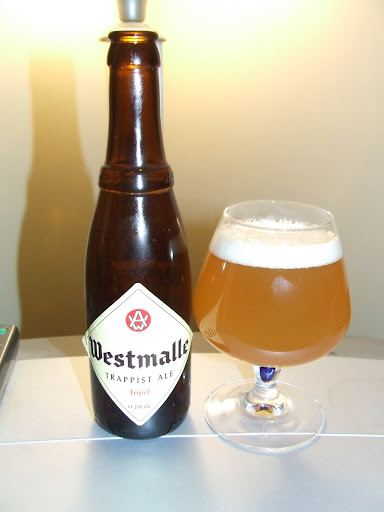
Westmalle Tripel is one of these beers. It has a rich golden hue that is cloudy from the yeast that is used for bottle conditioning the brew. The beer begins tart, with notes of citrus fruit that flesh out into a bready midpalate with a balanced floral qualities and a clean finish that belies the nearly 10 percent alcohol by volume.

If you enjoy beers like this, there are other great Trappist producers, including Chimay, Orval and Westyleteren that also make great Tripel ales. Chimay is the king, but none of these beers are worse than fantastic.

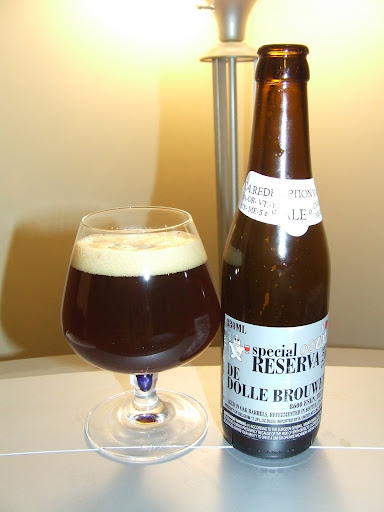
De Dolle is a small Belgian brewery near Brussels. Everything they make is delightful, and their labels are brightly colored and fun much like the ales. The Oerbier Special Reserve (of which I bought the last bottle in the store) is an oak aged cousin to the regular Oerbier. It has a ruddy color, with aromas of sour fruit and toast, with flavors of cherry, olive oil and smoke that are tempered by a creamy, frothy mouthfeel. It is pictured above.

Bottle conditioned monster brews are not solely the product of Belgium. Mikkeller, the most noted brewery in Denmark, also makes big beers that are rooted in the Belgian tradition. Although their brews are guided by the Belgian tradition, they are every bit the project and the passion of two Danish homebrewers who turned their projects into a microbrewery.

I have sampled a few other Mikkeller brews. The Black Hole is their most famous beer. But the last brew I tried was the Big Worse Barleywine, a massive, sweet beer as opaque as coal with enough malt to bake bread for a year. It's so big that it puts the Black Hole into Guiness' weight class. Big Worse has aromas of caramel and fruit that rise above the viscous brew. The hops are as over the top as the malt. This is a beer that drinks well now, but will probably show best with three or more years of bottle age, and should last forever and a day.

Denmark seems to be a hotbed for Belgian-style brews. Those who enjoy the spicy nature of Abbey ales will dig the Olfabrikken Abbey Ale. The aromas of cinnamon, cloves and pepper erupted from the glass of this double ale, and the flavors of malt, spices, prunes and brown sugar. The hops are subtle and well integrated. This is a solid, well made brew.

After scanning the blogosphere, apparently Olfabrikken has been bought by a Danish beverage conglomerate and production of the beer could be eliminated. Hopefully that is not the case; we've seen how Bud and Miller ruined the quality of beer in the States, and how other conglomerates have ruined distinctive brews worldwide. Hopefully this is not another of those sad tales.

Finally, America has also jumped on the Belgian style bandwagon. The last one I tried comes from California's North Coast Brewing. Their beer is made in the Belgian dark strong ale style, and even better, it's named after one of my favorite jazz legends Thelonious Monk.

Monk, the eccentric pianist, bandleader and composer, is one of the greatest American composers of all time. His compositions include "Round About Midnight," "Straight, No Chaser," "Bemsha Swing," and "Monk's Dream." He also has one of the coolest middle names ever--Sphere!

Brother Thelonious Abbey style Ale is as close to Heineken as Monk's compositions were to Hoagy Carmichael's oeurve. The deep brown ale is loaded with aromas and flavors of fruit, including cherry, Granny Smith apples and plum with underlying hints of spice and flowers. The beer is strong and medium sweet, with a long finish.

The brewery donates $2 to the Thelonious Monk Institute for Jazz for every case of Brother Thelonious sold, so you can also feel great enjoying it. Although the beer isn't produced by monks, it does celebrate Monk, so I'm sold. Check out the pictures below, and drink some Belgian (or Belgian style) beer in order to taste something as different as it is delicious.


Celebration of fermentation

04 February 2008

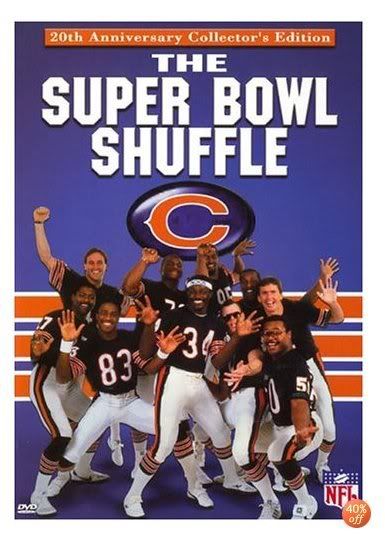
The Super Bowl Stumble


If one thing emerged for me last night during the game last night, it became evident that the Patriots aren't the best of all time. They were the second best team in the Super Bowl. I guess Mercury Morris was right.

But hey--there can only be one greatest team ever. I'm glad I can still say that it was the 1985 Chicago Bears. The only reason the Dolphins in 1972 were 17-0 was because they didn't have to play the 1985 Bears.

The Dolphins played teams with a combined winning percentage of .396. Big time wins, guys.

And the 1985 Bears beat Joe Montana, Jerry Rice and the 49ers pretty handily, so this argument keeps getting easier and easier to make. The Cowboys were the best at smoking cocaine, and that’s about it.

Even though it only lasted one year, the Bears would beat the pants off of your sorry best-team-of-All-Time if time travel would allow it. So sing along with me now as we celebrate the G.O.A.T. :

Bear down, Chicago Bears,
Make every play clear the way to victory.
Bear down, Chicago Bears,Put up a fight with a might so fearlessly.
We'll never forget the way you thrilled the nation,
With your T-formation.
Bear down, Chicago Bears,
And let them know why you're wearing the crown.
You're the pride and joy
of Illinois,
Chicago Bears, bear down.


01 February 2008

Bacchanalia--Rhone style


Don't ever let anybody tell you that the best wine from France comes from Bordeaux or Burgundy. Based upon grapes from those regions (Cabernet Sauvignon, Merlot, Pinot Noir, Chardonnay, and Sauvignon Blanc) being the most popular grape varietals not only from France but also worldwide, you'd believe that these were the only types of wine that mattered.

If you dig a little deeper, or really, a little further south in the French countryside, you would stumble upon the Rhone River valley. Nestled along the Mediterranean coast, the wines from this region include some of the most idiosyncratic wines in the world.

I love love love Northern Rhone wines, particularly those from the Hermitage and Cote Rotie regions. Red wines from Hermitage are 100 percent Syrah, and wines from Cote Rotie (which translates into English as the Roasted Slope) are allowed to contain small amounts of the heavily-perfumed white grape varietal Viognier. Single vineyard wines from either Cote Rotie or Hermitage can be absolutely divine. Ask me nicely and maybe I'll share a bottle with you.

I sampled the 2001 Cote Rotie by Michel and Stephane Ogier. It is a blend of grapes from the Cote Blonde (Blonde Hill) and Cote Brune (Brunette Hill). There are many explanations for how these names came about. The most romantic involves the two different areas were bequeathed to two daughters of a lord, and that the two daughters had two different hair colors and personalities. The blonde wines are prettier, more upfront and elegant, while the brown wines are bigger and more tannic.

The Ogier Cote Rotie showcased a deep garnet color, with aromas of berries, pepper, green olives and daisies. The 2001 vintage is considered good if unspectacular; however, this wine was showing magnificently, and should drink well for another 10 years.

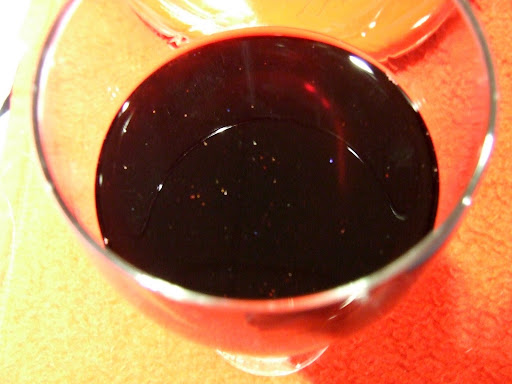
You can also enjoy the throw in my glass that I failed to decant properly. The sparkles in my glass, pictured above, demonstrate my inability to serve wine like a gifted sommelier. Oh well...you can't win them all.

Southern Rhone wines can be every bit as interesting as their Northern cousins. The flagship wine of the Southern Rhone is Chateauneuf-du-Pape. The name refers to the time when the Papacy was located in the Rhone rather than in Italy.

The wines from Chateauneuf can legally consist of as many as 13 grape varietals. I once memorized these grape names in hopes of impressing a drunken Robert Parker at a wine event, but I never got a chance to rattle them off to the wine snob to the stars. Maybe next time. The most important grapes are Grenache, Syrah, Mourvedre and Cinsault.

Chateaunef-du-Pape, after years of being lauded by the esteemed Mr. Parker, has increased in price as the ratings continued to skyrocket. A series of great vintages (1995, 1998 and 1999 in particular) put the prices in the stratosphere. Those of us with more pedestrian earning power, however, can still find a few nicely priced bottles of Cotes du Rhone, a wine made of similar grape varietals as the Chateauneuf-du-Pape wines, for a fraction of the price with many of the same flavors from the 2005 vintage.

I tried the 2005 Caves des Papes Heritage Cotes du Rhone. This wine was aged for 12 months in oak barrels, and consists of a blend of 70 percent Grenache, 25 percent Syrah and 5 percent Mourvedre. These wines are far lighter than Chateauneuf wines, but they still have tons of jammy fruit and a powerful character of pepper and spice that is often found in Southern Rhone wines. This is the type of wine that pairs well with spicy foods (I enjoyed mine with a great white bean chili pasta, and both were delicious). Also, as a side note, these wines are also owned by a member of the Ogier family like the first Cote Rotie.

Two of the Southern Rhone grape varietals have travelled quite well. Syrah, used in both the South and the North, is the most widely planted grape in Australia, where the natives call the grape Shiraz. Syrah is a muscular wine with berry fruit and spicy notes. Grenache is also widely planted in other areas worldwide. It is a more restrained varietal, lighter in both color and flavor.

Although less famous than other grape varietals, Grenache is one of the world's most planted grapes. It can be found in France, Spain, Italy, the United States and Australia. It has a garnet color, and it can possess aromas of strawberries, cherries and earth.

Turkey Flat
in Australia produces one of the country's most heralded Grenache wines. The wine displays a bright violet color with bright strawberry fruit, notes of leather and graphite and a firmly tannic backbone that comes across in the finish. The wine would pair beautifully with a mushroom risotto.

Finally, you can rest easy if you believe that interesting wines made from Rhone grapes are only red. White wine drinkers can find interesting choices in white wine from Chateauneuf-du-Pape, Hermitage, Condrieu and Cotes du Rhone, amongst others. Some of the more well-travelled white grapes from the Rhone include Grenache Blanc, Marsanne, Rousanne and Viognier.

D'Arenberg, another winemaker from Australia, specializes in Rhone grape varietals. I samled the 2006 Hermit Crab, a blend of Viognier (a peachy, floral wine with a vibrant acidity) and Marsanne (a classic Rhone blending grape with flavors of nuts and minerals). Together, the wine displays pretty tropical fruit notes with a waxy undercurrent. The wine is named after the Hermit crabs that inhabit the vineyard, with an approving nod to Hermitage, the homeland of Marsanne. It was also rated 90 points by the Wine Spectator and recognized as one of the top 100 wines of the year in 2007 for those who keep track of those petty details.

But these are just a few of the Rhone (and Rhone style) wines that are far more interesting than the cookie cutter Cabs and Chards churned out around the globe by wineries with little to no panache. Pop a cork on one of these wines, and taste something beautiful that is unlike anything else you've ever sampled before.
Celebration of fermentation

31 January 2008

Home Depot


Home Depot has announced that they will lay off 10 percent of their employees at their Atlanta headquarters. Analysts are citing the downturn in the housing market and the problematic economy as being responsible for the terminations. I have an alternate theory. With Michael Vick getting off so easily after his dogfighting ordeal, it seems like upper level management of the Depot (and the Falcons) had to make somebody pay the piper.

30 January 2008

Die Hippie, Die!


It's official--U2 is managed by Eric Cartman.

Actually, that isn't true. The cultural dinosaurs, following on the heels of their induction into the Rock and Roll Hall of Fame, are actually managed by a relic named Paul McGuiness. U2's manager delivered a scathing diatribe at the Midem Music Conference in Cannes about the state of the music industry.

In his rant, McGuiness demonstrated how he has his finger directly on the cultural pulse of the world by blaming hippies for the downfall of the music industry. With management like that, U2 should keep putting out shit music and receiving unbelievable adulation for their sorry efforts for years to come.

McGuiness is (more so than the hippies) a symptom of a music industry that is so out of touch with its audience that it no longer can conceptualize how to reach them. Reality talent farms like "American Idol" and the newest junket into the genre "Gone Country", where CMT tries to recycle has-beens like Bobby Brown and Dee Snider into country music superstars, are another symptom of how those in charge of the business blame their problems on everybody BUT themselves.

And Mr. McGuiness, do you blame the old Grateful Dead-era hippies, or the newfangled Yonder Mountain String Band hippies for the shortages in your music revenue? Whoever the culprit is, I'm sure this helps explain how Sting and his merry band of hippies The Police were the highest grossing touring band of the year, even topping the second place Rolling Stones (the band that is credited with ending the 1960s, by the way).

Maybe U2 should hire Thom York from Radiohead to manage all their future projects. Radiohead still seems to sell pretty well, even with all of their hippie album releases. Plus, unlike Paul McGuiness, Radiohead started their music career in the 20th century, which puts Radiohead 90 or 100 years ahead of the McGuiness and his reactionary philosophy.

Whatever the case may be, hopefully McGuiness is seen for exactly what he really is...an out of touch relic from a bygone era of music. Peace and love to you Paulie McG...best of luck in your antique endeavors, and leave the music business to those who can use counterculture terminology that comes after the year 1987.

29 January 2008

Celebration of fermentation


I have an absolute backlog of tasting notes that I'm going to attempt to get up as part of my quasi-regular beverage column. Now that the holidays are over, I have plenty of seasonal brews to wax philosophic about. There is also my regular army of Belgian (and Belgian-style) brews. There are many other beers that don't fit easily into these preexisting categories, and a number of wines that will round out the prose. Enjoy!


Winter just might be the most wonderful time of the beer. The majority of the world's breweries, from the masters in Germany to those who produce industrial quantities of rice swill in St. Louis and Milwaukee, produce a special beer in the winter season. Summer beers are also extremely popular offerings. In my humble opinion, there is a great deal more character in the winter brews than there is in the summer counterparts. Winter beers are a great way to warm the soul if you're trapped in a snowed-in basement.

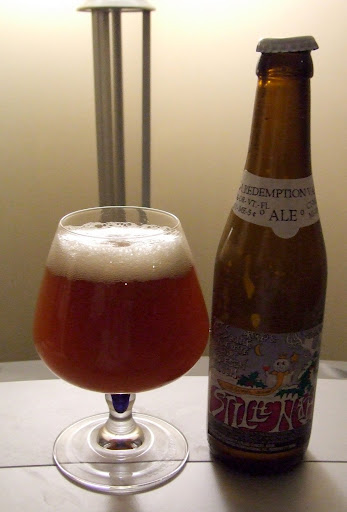
One of the greatest brews produced every holiday season comes from De Dolle, a Belgian craft brewer that hits the mark every time (see the Mad Bitch and Oerbier for evidence). Their seasonal goes by the name Stille Nacht, which translates into English as Silent Night. The white candy sugar gives this brew its seasonal kick. I definitely always look for the Frosty the Snowman artwork every year, as should you. But this is a brew that is used to the alt tab scrutiny that often accompanies the season. Buy anything and everything you can purchase from this Belgian gem.

Rogue's seasonal brew embodies everything I love and everything I hate about winter beer. Santa's Private Reserve is an uber-hopped version of the Saint Rogue Red Ale. The hops are augmented by a mystery strain identified by head brewer John Maier as "Rudolph," and these hops are not used in the red ale. I really like winter ales like Rogue that base their flavor profile more on malt and hops than they do on adjunct spices. However, from a marketing standpoint, I believe that framing beer with the Christmas theme limits those who will drink the beer and when they will drink it. This beer would taste good all winter long; however, it looks out of date December 26th.

Great Divide's winter brew, Hibernation Ale, is the original craft strong ale from the Rocky Mountain state. The ale is cellar aged for six months before release, and the age tempers the rich malt and aggressive alcohol character of the brew. This beer should also greatly improve with a few additional years of bottle age--highly recommended!

Finishing off the seasonal beers (and beating out all the other 2008 equinox offerings) is the E.S.B. from craft brew pioneer Sierra Nevada. The term E.S.B. traditionally refers to a strong British style pale ale, and the acronym would stand for "Extra Special Bitter." In the case of Sierra Nevada, E.S.B. stands for Early Spring Beer. It is a fresh, unfiltered beer with an outstanding balance of malt and hop character, and it should provide an early relief for beer drinkers who are already fed up with winter ales.

Check out the pictures below, and I'll return later with my remaining tasting notes.


Celebration of fermentation

26 January 2008

Cameron's American Bistro


While there may not be a cornucopia of choices for vegetarian diners at Cameron's, the classic American establishment, which is the flagship of the Mitchell restaurant empire, carefully selects and prepares dishes that are so yummy, you'll probably forget that you were limited in your menu options.

Cameron's menu changes seasonally. They always seem to offer a vegetarian entree alongside one or two vegetarian appetizers. The latest menu had dead animals in all of the salads, which was a mild disappointment, but they made up for it with great first course options like the goat cheese beignets (pictured above), served in a tomato coulis and basil oil with ricotta cheese. They were savory, tart and delicious.

My main course was the bistro vegetable plate, which came with a breaded eggplant Napoleon in goat cheese, roasted red peppers, oven dried tomatoes, broccoli raab and artichoke hearts in a cilantro pesto sauce. The presentation was artfully executed, and the course was very good.

The bread comes with a whole roasted garlic clove to spread with the butter. I love love love roasted garlic with fresh bread, and the Cameron's rendition is no exception.

The wine list is solid if unspectacular, consisting mostly of basic varietal wines from the Left Coast. It seemed to me as if they could have fleshed out the beverage options in a better fashion in order to keep up with the dynamic kitchen fare. Nonetheless, I had to deal with an A to Z Pinot Gris, the Chalone Pinot Noir and a 20-year Fonseca Tawny Port. There is also a reserve list with more trophies from the Pacific coast.

The service was attentive, sharp and efficient. While they worked well during my early dinner hour, they may have been stretched thin when the place filled up closer to 7 p.m. It would have been difficult to maintain this level of service if the server was helping twice as many people.

There weren't tons of options for vegetarians, but the limited selection I tried was still very good. Mitchell's kitchens are always very talented, so I'm sure they could work around any dietary restrictions that aren't covered by the pre-existing menu items if they were given advance warning.

Check out the pictures below.


Cameron's

Cameron's American Bistro on Urbanspoon

19 January 2008

Tria Greek Kuzina


Tria is located in Powell. There is only one reasonable way to get to Powell, and if it's rush hour, that way is a disaster. Despite the circa 1879 traffic design that makes the trip a bit of a headache, Tria is well worth the trip out to Powell.

Tria offers traditional Greek and other Mediterranean fare, prepared in an authentic fashion with high quality ingredients. There is saganaki (flaming cheese) exploding all over the place (and of course I had to try it to satisfy my inner pyro).

The vegetarian entrees are mostly Greek pasta dishes made with varying combinations of fresh vegetables, olive oil, garlic and feta or some other Greek cheese.

The wines are well chosen. The Rioja by the glass was a great value, with bright cherry fruit and a clean finish that grows as it lingers on the palate. The mixed drinks are also very good, with Three Olives flavors as the house plain and flavored vodkas.

Despite the treacherous wagon trail ride to Powell, Tria is worth the trip. Check out the photos below.


Tria

Tria Greek Kuzina on Urbanspoon